SparkPlugReplacementCost.com is an independent cost reference guide. Not affiliated with any auto parts retailer, repair chain, or vehicle manufacturer. Prices are estimates based on national averages.
Home Warning Signs

7 Signs Your Spark Plugs Need Replacing (and What It Costs to Ignore Them)

Spark plugs do not fail suddenly. They degrade gradually. Each symptom below gets more expensive the longer you wait. A $150 plug job becomes a $1,200 catalytic converter replacement if you drive through active misfires for months.

$80-$200

Cost to replace spark plugs now

$800-$2,500

Catalytic converter damage from misfires

$200-$400

O2 sensor fouling from rich exhaust

30%

Potential MPG loss from worn plugs

1

Rough Idle

Early warning

The engine shakes or sounds uneven when idling at a stop. This is the first sign of plug wear. A worn plug occasionally fails to fire at low RPM where voltage demand is highest. If your car shakes at a red light but smooths out at highway speed, check the plugs. This symptom at the correct mileage interval means replace now.

Fix it now

$80 - $200

Ignore it and risk

$800 - $2,500 (catalytic converter)

2

Poor Fuel Economy

Measurable cost

Worn plugs produce an incomplete combustion cycle. Unburned fuel exits through the exhaust instead of contributing to power. Studies show worn plugs can reduce fuel economy by up to 30 percent. At current gas prices, a 10 percent MPG drop on a 15,000-mile-per-year driver costs $150 to $250 in extra fuel annually. The plugs cost less than one year of wasted gas.

Fix it now

$80 - $200

Ignore it and risk

$200 - $500/year in wasted fuel

3

Slow or Hesitant Acceleration

Performance loss

The car feels sluggish when you press the gas, especially when accelerating from low speed. This hesitation is caused by misfires during the compression stroke when the cylinder is under load. It is often misdiagnosed as a transmission problem. Before spending $500 on a transmission service, replace the spark plugs if they are approaching their service interval.

Fix it now

$80 - $200

Ignore it and risk

$150 - $400 (misfire diagnosis added)

4

Engine Misfires

Urgent - stop driving

A misfire means a cylinder is not completing its combustion cycle. You will see check engine codes P0300 (random misfire) through P0308 (cylinder 8 misfire). An active misfire sends raw, unburned fuel into the exhaust. This fuel ignites in the catalytic converter, overheating it. Sustained misfires can destroy a catalytic converter in as little as a few thousand miles of continued driving.

Fix it now

$80 - $200

Ignore it and risk

$800 - $2,500 (catalytic converter damage)

5

Hard Cold Starts

Seasonal pattern

If your engine cranks 3 to 5 times before firing in cold weather but starts fine when warm, the plugs are worn. Cold starts require a richer fuel mixture and a stronger spark to overcome the thick cold oil and the cold cylinder walls. Worn plugs cannot reliably produce that stronger spark. Every long crank cycle stresses the starter motor and drains the battery more than a normal start.

Fix it now

$80 - $200

Ignore it and risk

$200 - $400 (battery and starter stress)

6

Check Engine Light (P0300-P0308)

Scan before assuming

Get the code scanned before assuming the worst. AutoZone, O'Reilly, and Advance Auto Parts offer free OBD-II scans. A P0300 series code means the engine management system detected a misfire. This is one of the most common codes and is frequently caused by worn spark plugs. Replacing the plugs and clearing the code is the correct first step before any expensive diagnosis.

Fix it now

$80 - $200 (or $0 if early)

Ignore it and risk

$150+ in diagnostic fees added

7

Engine Knocking Under Load

Serious - act immediately

A knocking or pinging sound under acceleration or heavy load can indicate pre-ignition caused by degraded spark quality. Worn plugs with a large electrode gap can cause inconsistent ignition timing, allowing the fuel-air mixture to auto-ignite before the spark fires. Pre-ignition produces shock waves inside the cylinder that physically hammer the piston crown. This is the most damaging scenario and requires immediate attention.

Fix it now

$80 - $200

Ignore it and risk

$2,000 - $8,000+ (piston and head damage)

How to Inspect Your Spark Plugs

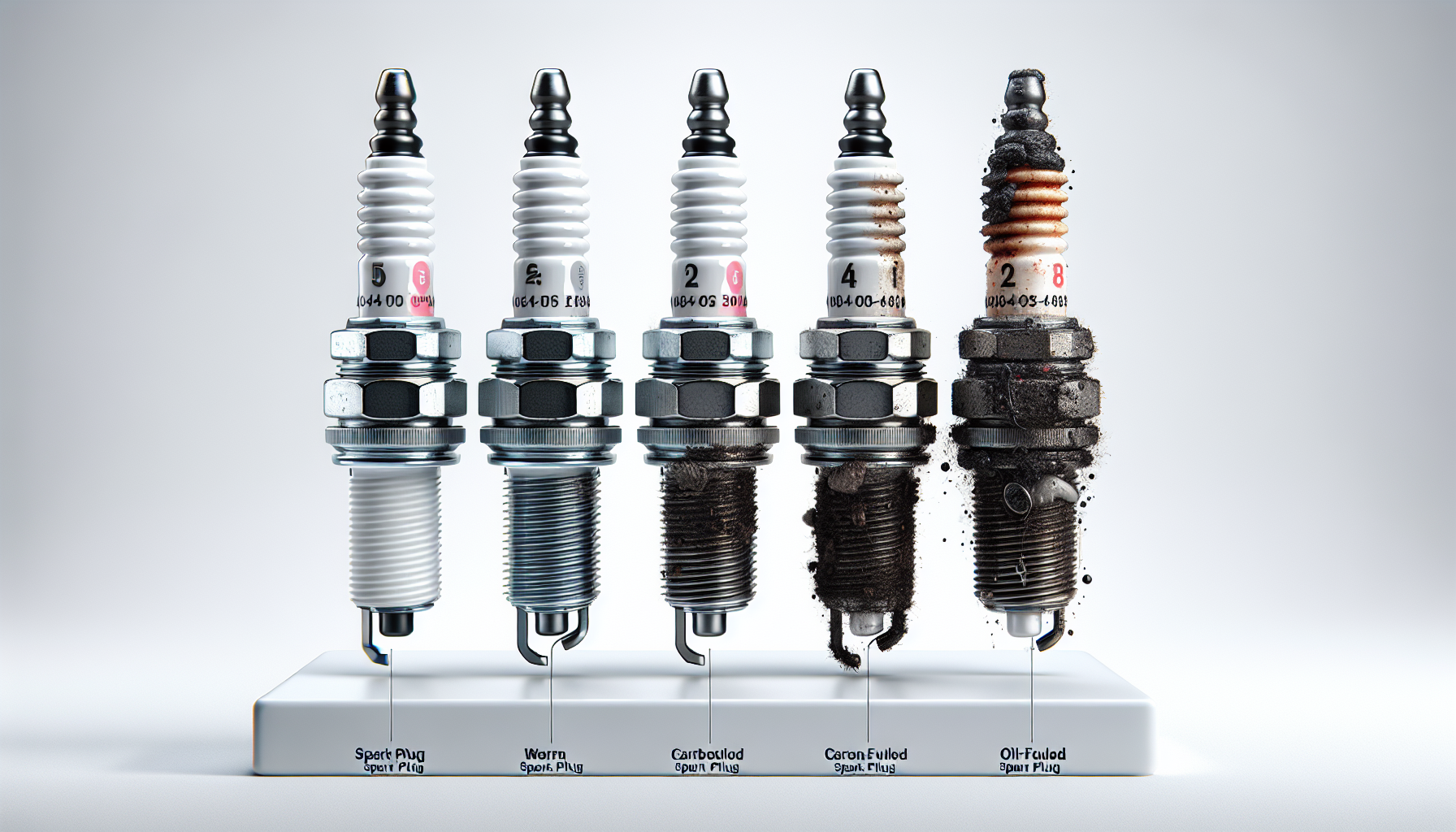
Four spark plugs shown in cutaway view: new, worn, carbon-fouled, and oil-fouled, with labeled electrode conditions

Left to right: new plug with clean electrodes, worn plug with eroded gap, carbon-fouled plug with black deposits, oil-fouled plug with wet oily coating.

Normal

Light tan or grey ceramic, clean metal electrodes, small sharp gap. Plugs are working correctly.

Worn

Rounded or heavily eroded electrode. Large visible gap. Replace immediately - this plug is misfiring regularly.

Carbon Fouled

Dry black soot coating the ceramic. Engine is running rich (too much fuel). Fix fuel issue then replace plugs.

Oil Fouled

Wet, oily black deposits. Not a plug problem - this is a valve seal or piston ring issue. Replace plugs and investigate the oil source.

When to Stop Diagnosing and Just Replace Them

If your plugs are at 80 percent or more of their rated mileage and you have any symptom listed above, just replace them. Diagnosing which cylinder is misfiring, pulling plugs to inspect, and running compression tests costs more in shop time than the plugs themselves. At $80 to $200 for a 4-cylinder, the replacement cost is less than two hours of diagnostic labor at most shops.

Common Questions

Can bad spark plugs damage my engine?

Yes. Prolonged misfires from worn spark plugs can damage the catalytic converter ($800 to $2,500 to replace), foul oxygen sensors ($200 to $400 each), and wash cylinder walls with excess fuel, increasing oil consumption. A $150 plug job left undone for 20,000 miles of active misfiring can cascade into $1,500 or more in additional repairs.

What does a spark plug misfire feel like?

An active misfire can feel like a rhythmic stumble or shake at idle, a hesitation when accelerating from a stop, a full-body shudder at highway speed, or a popping sensation under heavy throttle. The check engine light will usually illuminate with P0300 through P0308 codes, which correspond to random or cylinder-specific misfires.

How do you tell if spark plugs are bad by looking at them?

Remove one plug and inspect the electrode end. A normal plug has a light tan or grey color on the ceramic and clean metal electrodes. A worn plug shows a severely eroded or rounded electrode with a large gap. A carbon-fouled plug is coated in dry black soot. An oil-fouled plug has wet, black oily deposits, which points to a valve seal or piston ring problem.

Scheduled Replacement IntervalsUnderstand Your Plug TypePull and Inspect a Plug YourselfMisfire Could Also Be a CoilGet a Cost Estimate